Circuit Collapse
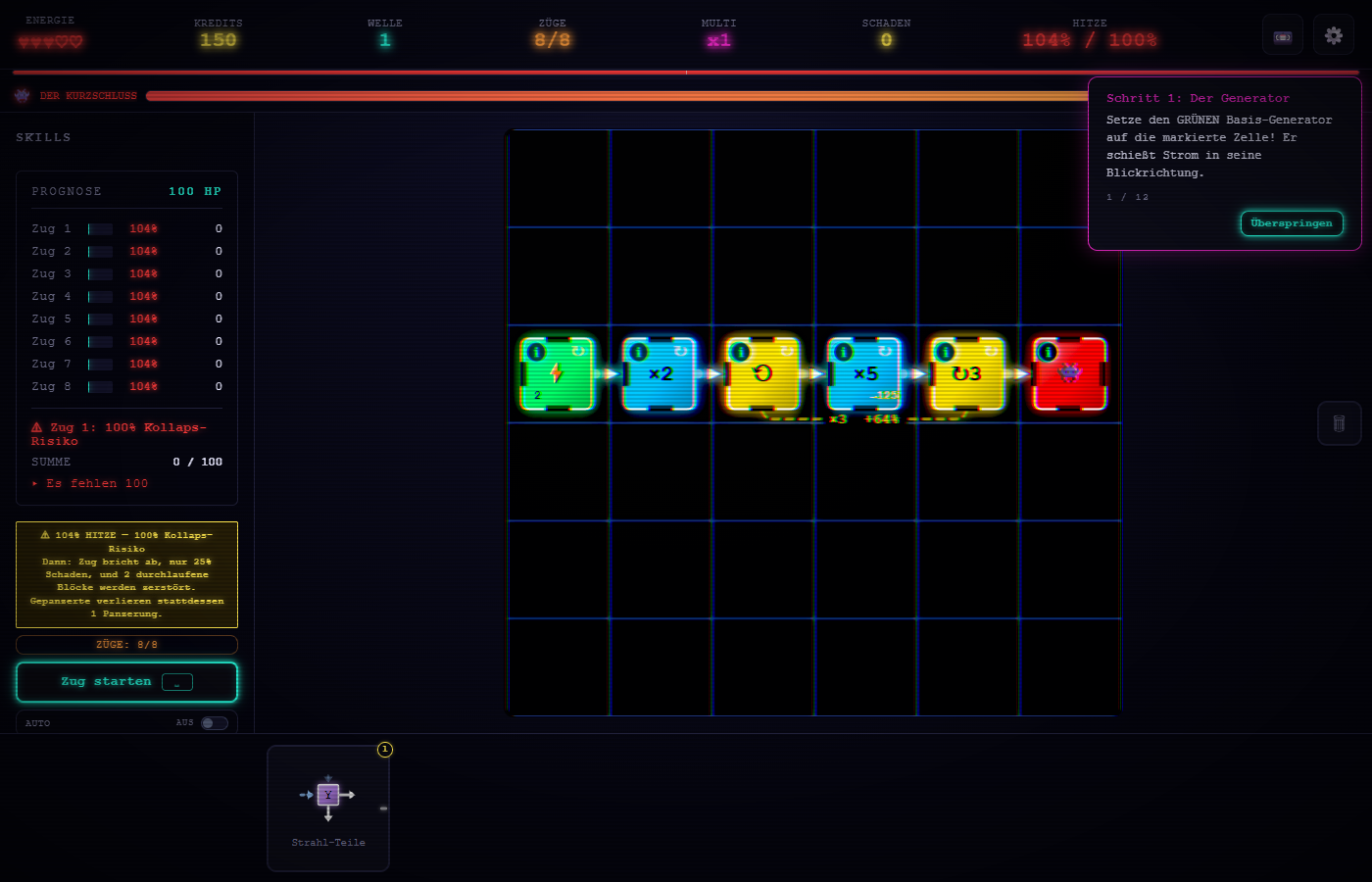
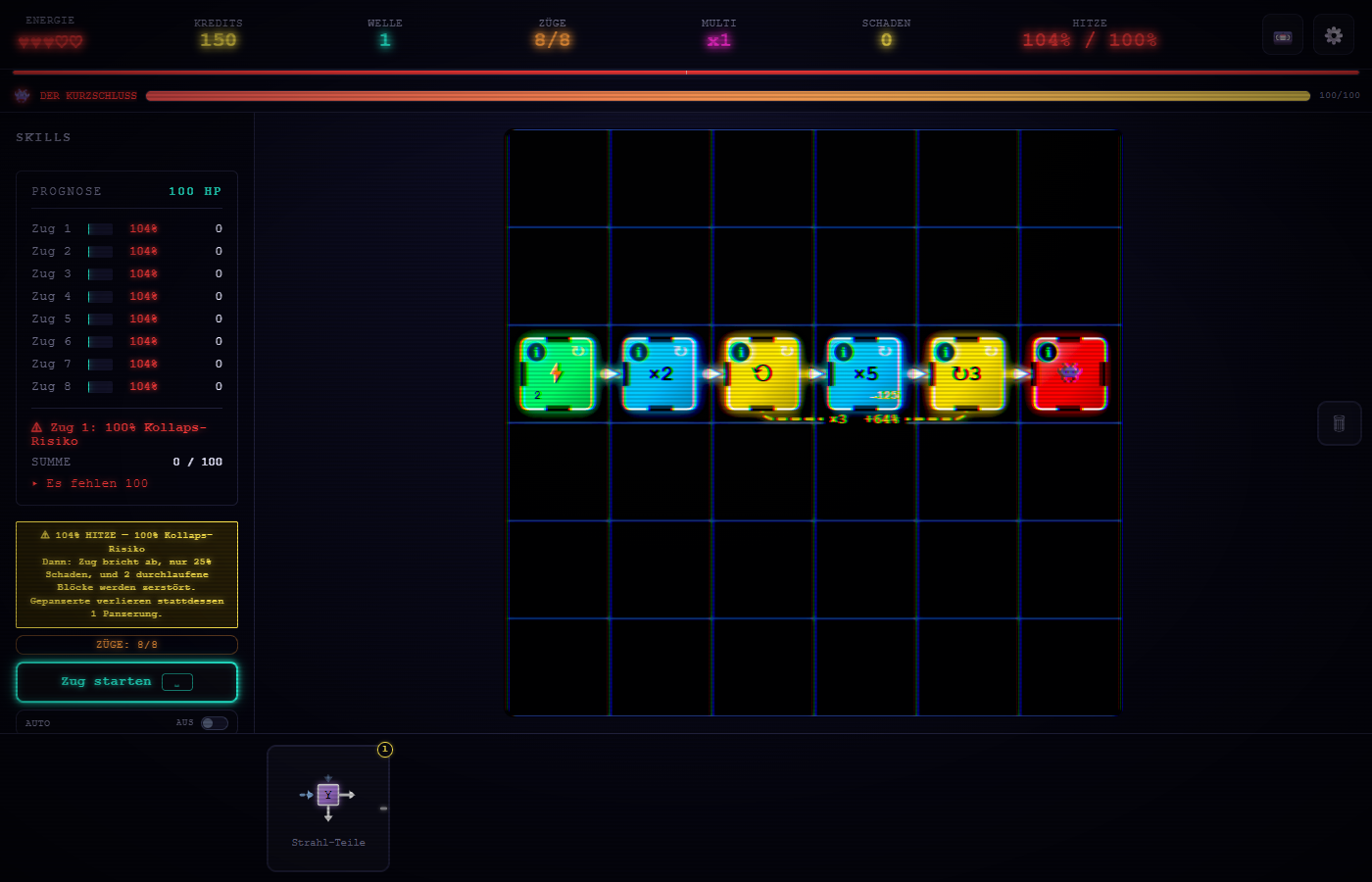
CIRCUIT COLLAPSE ist ein Retro-Neon-Puzzle über Strom, Schleifen und Overloads. Du baust auf einem 6×6-Feld einen Schaltkreis aus Generatoren, Verstärkern, Splits und Schleifen — und feuerst das Signal auf einen Boss, bevor dir die Züge ausgehen.
CIRCUIT COLLAPSE is a retro neon puzzle about power, loops and overload. Build a signal chain on a 6×6 grid out of generators, boosters, splitters and loops — and blast a boss before your turns run out.
⚡ FEATURES / DE
- Schaltkreis-Puzzle — Reihenfolge, Richtung und Ports entscheiden, ob dein Signal überhaupt ankommt
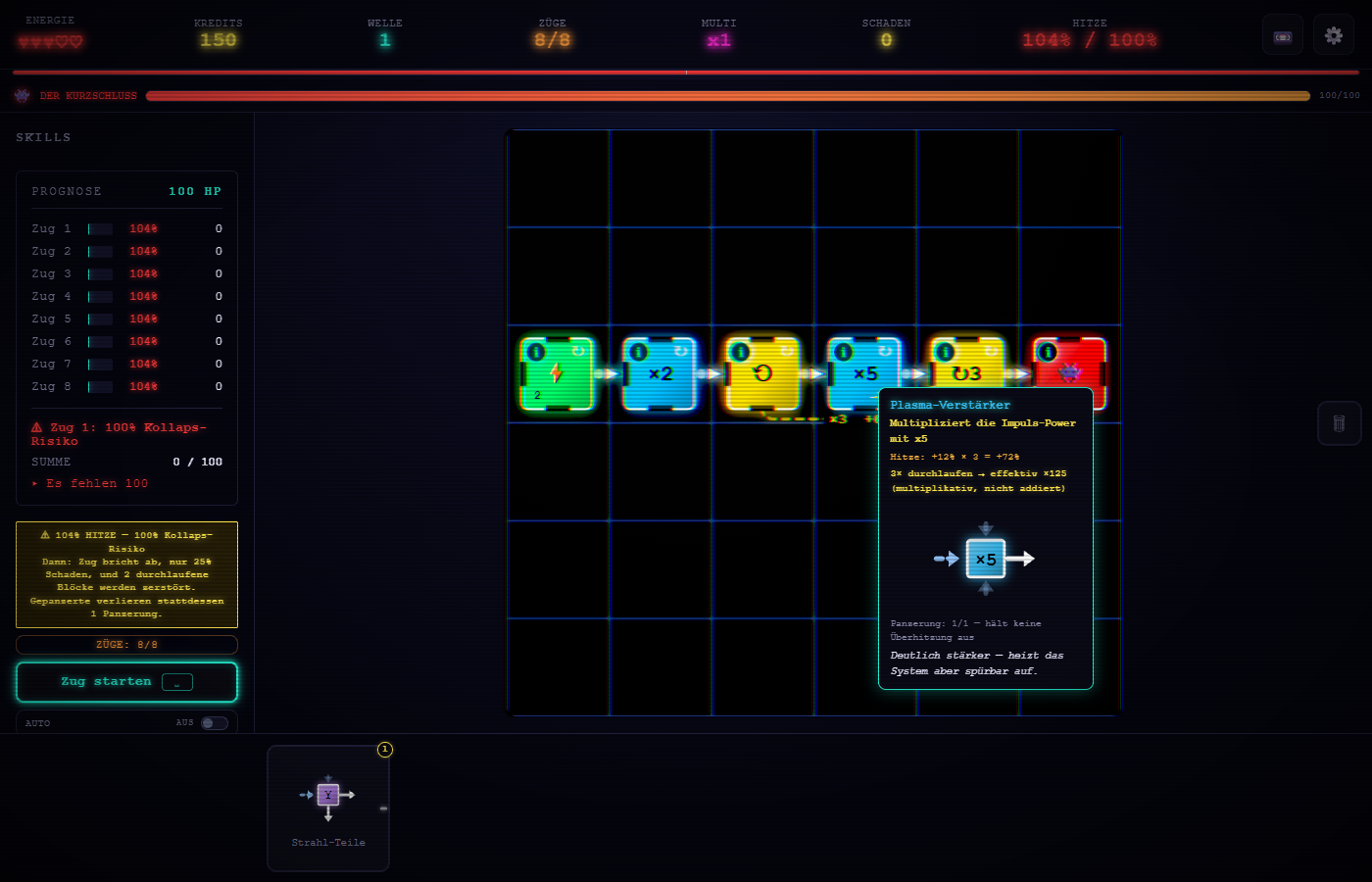
- Echte Schleifen-Mechanik — Rücksprünge multiplizieren die Power eines Verstärkers mehrfach (multiplikativ, nicht additiv — ×2 dreimal durchlaufen wird ×8, nicht ×6!)
- Hitze- & Kollaps-Risiko — je stärker der Loop, desto heißer die Kette
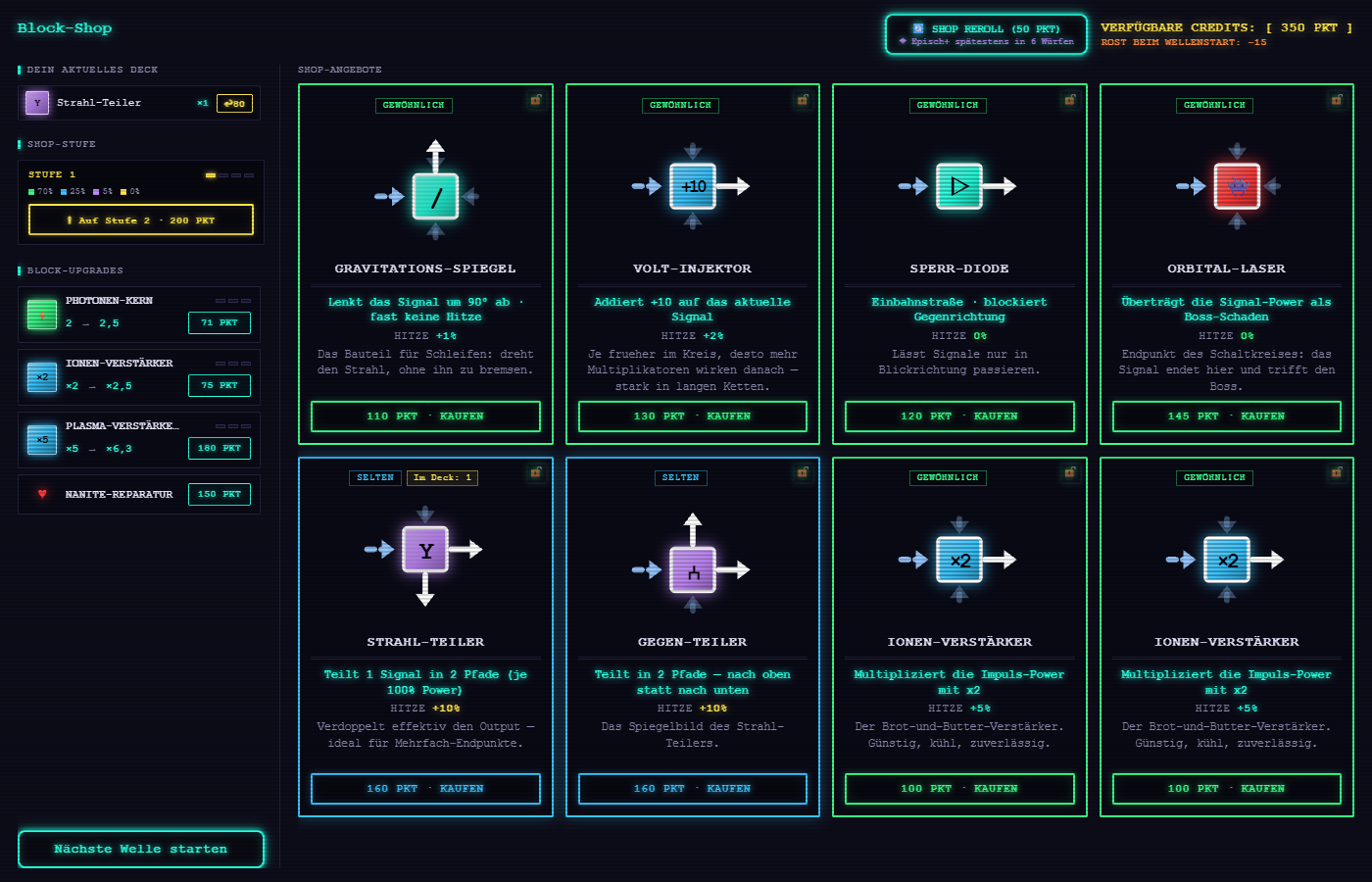
- Relikte, Upgrades & Shop — Runs bauen sich über mehrere Wellen auf
- Komplett zweisprachig (DE/EN), Tastatur-Shortcuts (Leertaste = Zug starten), läuft im Browser — keine Installation
⚡ FEATURES / EN
- Circuit puzzle — order, direction and ports decide whether your signal even arrives
- Real loop mechanic — jump-backs multiply a booster's power repeatedly (multiplicative, not additive — three passes through ×2 becomes ×8, not ×6!)
- Heat & collapse risk — the stronger the loop, the hotter the chain
- Relics, upgrades & shop — runs build up over several waves
- Fully bilingual (DE/EN), keyboard shortcuts (Space = start turn), runs in the browser — no install
🛠 MAKING OF — VIBE-CODED IN ~2 TAGEN / DE
Dieses Spiel ist ein kleines Experiment: wie weit kommt man heute in rund zwei Tagen, wenn man ein Spiel komplett mit KI-Unterstützung (Claude) baut — Code, Balancing, UI, sogar die Musik (Suno)? Die ehrliche Antwort: erstaunlich weit, aber nicht von allein.
Ein paar Erkenntnisse aus dem Prozess:
- LLMs können heute wirklich sehr viel — sauberen Code, konsistentes Design, schnelle Iteration über viele kleine Screens hinweg.
- Aber sie folgen Anweisungen, sie entwickeln keine eigene Vision. Jede Design-Entscheidung in diesem Spiel — die Schleifen-Mechanik, wie die Sidebar aussehen soll, was ins Menü gehört — kam von einem Menschen, der genau wusste, was er sehen wollte, und das auch immer wieder korrigiert hat.
- Spiellogik und Balancing lassen sich nicht komplett der KI überlassen — dafür ist sie (noch) nicht geeignet. Sie braucht ständige menschliche Kontrolle, gerade bei Zahlen: an einer Stelle im Spiel wurde z. B. sichtbar gemacht, dass ein Loop-Multiplikator multiplikativ statt additiv wirkt (×8 statt ×6) — ohne genaues Hinsehen wäre das unbemerkt geblieben.
- Am schnellsten ging es dort, wo die Idee schon klar war und nur noch umgesetzt werden musste. Am langsamsten dort, wo erst durch Ausprobieren klar wurde, was eigentlich gemeint war.
Auch aus Sicht des Modells, das mitgebaut hat: Die eigentliche Arbeit war selten "Code schreiben" — das ist der leichte Teil. Der eigentliche Wert entstand dort, wo der Mensch ein Ergebnis ansah, sagte "nein, so nicht" und genau erklärte, warum. Ohne dieses ständige Feedback wäre vieles technisch korrekt, aber am eigentlichen Ziel vorbei gewesen.
🛠 MAKING OF — VIBE-CODED IN ~2 DAYS / EN
This game is a small experiment: how far can you get today in roughly two days, building a game entirely with AI assistance (Claude) — code, balancing, UI, even the music (Suno)? The honest answer: surprisingly far, but not on its own.
A few takeaways from the process:
- LLMs can genuinely do a lot today — clean code, consistent design, fast iteration across many small screens.
- But they follow instructions, they don't develop their own vision. Every design decision in this game — the loop mechanic, what the sidebar should look like, what belongs in the menu — came from a human who knew exactly what they wanted to see, and kept correcting it.
- Game logic and balancing can't be fully handed to AI — it isn't suited for that (yet). It needs constant human oversight, especially with numbers: at one point in the game, for example, it became visible that a loop multiplier compounds multiplicatively rather than additively (×8 instead of ×6) — without a close look, that would have gone unnoticed.
- Things went fastest where the idea was already clear and just needed implementing. Slowest where it only became clear through trial and error what was actually meant.
Even from the model's side that helped build it: the actual work was rarely "writing code" — that's the easy part. The real value came from where the human looked at a result, said "no, not like that" and explained exactly why. Without that constant feedback, a lot would have been technically correct but missed the actual goal.
Code & Design mit KI-Unterstützung (Claude) · Musik mit Suno generiert · gebaut als kleines
Zwei-Tage-Experiment, kostenlos zum Spielen.
Code & design with AI assistance (Claude) · music generated with Suno · built as a small
two-day experiment, free to play.
Leave a comment
Log in with itch.io to leave a comment.